Energetic Materials
RDX (Cyclotrimethylenetrinitramine)
C₃H₆N₆O₆, CAS 121-82-4. A secondary high explosive, also known as hexogen or cyclonite, used as a munitions fill and as the energetic component in compositions such as Composition B and Composition C-4. Military-grade material can be sourced to the buyer's specification, or to a recognised standard such as MIL-DTL-398 where the producer certifies to it, from producers screened for ownership, sanctions and licensing.
- Form
- White crystalline powder
- Packaging
- UN-certified, Class 1.1D
- Documentation
- CoA and SDS with every batch
- Terms
- FOB · CFR · CIF, under export licence
Identity
Chemical Identity
Reference data for the substance in its standard state.
- Other names
- Hexogen; cyclonite; T4; cyclotrimethylenetrinitramine
- IUPAC name
- 1,3,5-Trinitro-1,3,5-triazinane
- Chemical formula
- C₃H₆N₆O₆
- Molar mass
- 222.12 g/mol
- CAS number
- 121-82-4
- EC number
- 204-500-1
- UN number
- UN 0072, UN 0483 or UN 0391, by form
- Appearance
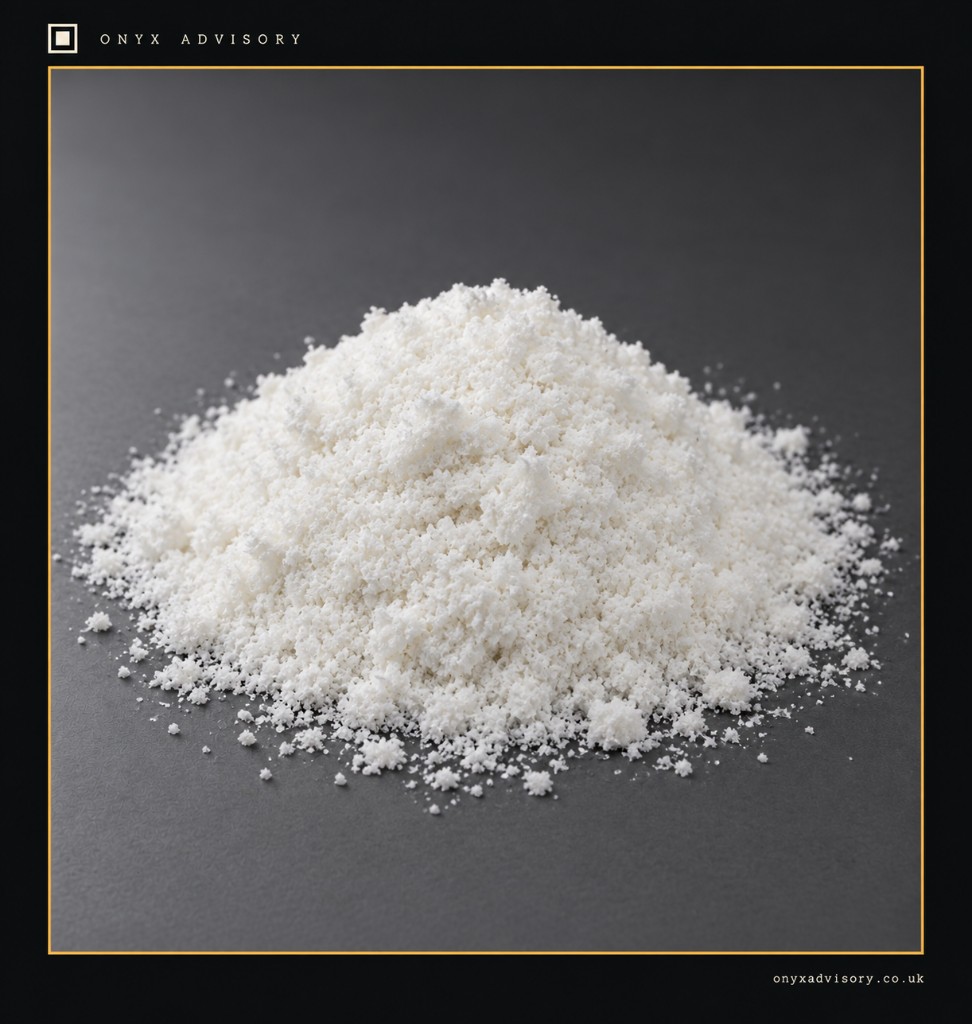
- White crystalline solid, odourless
- Density
- 1.81 g/cm³
- Melting point
- 205.5 °C
- Solubility in water
- About 60 mg/L at 25 °C
Grades
Types and Conditioning
Buyers usually specify the manufacturing type and the form in which the material is to travel. Other types and granulations can be sourced to the agreed specification.
- Type I
- Nitric-acid process
- The type most often specified for general military compositions. Typical HMX content is held to 5% or less where the producer certifies to MIL-DTL-398.
- Type II
- Acetic-anhydride process
- Bachmann-process material. HMX content is higher than Type I, typically in a band of about 4–17% where the producer certifies to MIL-DTL-398.
- Transport conditioning
- Dry, wetted with at least 15% water, or phlegmatised with wax, to the buyer's specification and the transport classification that follows from that form.
Specification
Typical Specification Parameters
The limits below are typical of military-grade Type I requirements. Each supply is certified against the specification agreed with the buyer.
Identity and purity
- Appearance
- Small white crystals, odourless, no visible impurities
- Melting point
- ≥ 200 °C
- Acidity, as HNO₃
- ≤ 0.05%
- Insoluble on US No. 60 sieve
- ≤ 5 particles
- Acetone-insoluble matter
- ≤ 0.05%
- Inorganic insoluble matter
- ≤ 0.03%
- Impact sensitivity, Kast
- ≤ 84%, where the producer certifies it
Typical granulation
- Through US No. 20
- 95–100%
- Through US No. 50
- 70–100%
- Through US No. 100
- 20–90%
- Other classes
- To the buyer's sieve curve
Each supply is certified against the specification agreed with the buyer.
Quality
Documentation and Acceptance
-
Certificate of analysis
Each batch ships with a CoA covering, as the buyer specifies: appearance, melting point, acidity, insoluble matter, granulation, impact sensitivity and any other limits in the agreed specification.
-
Incoming inspection alignment
Acceptance criteria, rejection limits and retest arrangements are agreed in the contract, aligned with the buyer's incoming inspection procedure.
-
Safety data sheet
The safety data sheet for the supplied grade accompanies every batch and is available to verified buyers before order.
Logistics
Packaging and Transport
- Packaging
- Packed to the buyer's requirement in sealed UN-certified packaging approved for the assigned UN number: fibre drums, steel drums or equivalent, with polyethylene liners. Palletised for road, rail and sea transport under ADR, RID and IMDG.
- Transport classification
- RDX is typically Class 1.1D. Dry or desensitised material is commonly assigned UN 0072 when wetted with at least 15% water, UN 0483 when desensitised, or UN 0391 when mixed with wax. Classification is confirmed per batch with the transport documentation.
- Transport modes
- Volume shipments move by road and sea with licensed explosives carriers. Air freight is tightly restricted under IATA and is used only where the classification and the airline permit it.
Commercial
Commercial Terms
- Minimum order
- Quoted per requirement.
- Lead time
- Quoted per requirement. Lead time is governed largely by export authorisation in the producer's country.
- Incoterms
- FOB, CFR or CIF.
- Payment
- Settled through independent, regulated banks against agreed delivery conditions.
- Country of origin
- Disclosed to verified counterparties.
Safety
Hazard Identification
Typical GHS classification of dry RDX. Wetted or phlegmatised material may carry a different transport class. The safety data sheet for the supplied grade governs.
-
 GHS01 Explosive
-
 GHS06 Toxic
-
 GHS08 Health hazard
- Signal word
- Danger
- H201
- Explosive; mass explosion hazard
- H301
- Toxic if swallowed
- H370
- Causes damage to organs
- H373
- May cause damage to organs through prolonged or repeated exposure
Compliance
Export Controls and End Use
- Controlled good
- RDX is a controlled item under military and dual-use export control lists. Supply proceeds under export authorisation in the producer's country and, where Onyx arranges supply between third countries, under UK trade-control licensing.
- End-user documentation
- An end-user certificate signed by the end user, in the format prescribed by the producer's export authority, is obtained and verified before any commitment is made, with delivery verification where the licence requires it. Counterparties, end users and destinations are screened in line with the firm's compliance policy.
Enquiries
Specifying a Requirement
A complete requirement allows a producer to be matched and a quotation prepared in one pass. Include as much of the following as applies.
- Type (I or II) and any recognised standard the producer must certify to
- Granulation or particle-size distribution, including sieve limits
- Dry, wetted or wax-coated form
- Assay, melting point, acidity and insoluble-matter limits
- Order quantity and expected annual volume
- Certificate of analysis content and incoming inspection criteria
- Packaging and palletisation requirements
- Delivery timeline, preferred Incoterms (FOB, CFR or CIF) and destination port
- End user and end use, with end-user documentation available on request
Send a Requirement
Send the specification, quantities, delivery timeline, preferred Incoterms and destination. Enquiries are handled in confidence.