Energetic Materials
Ammonium Perchlorate (AP)
NH₄ClO₄, CAS 7790-98-9. The principal crystalline oxidizer in composite solid propellants, used in space launch vehicles and sounding rockets, and in solid rocket motors for defence and aerospace programmes. Propellant-grade material can be sourced to the buyer's specification, or to a recognised standard such as MIL-A-192B where the producer certifies to it, from producers screened for ownership, sanctions and licensing.
- Fractions (d50)
- Coarse 250–400 µm · Medium 50–75 µm
- Packaging
- UN-certified drums, PE-lined
- Documentation
- CoA and SDS with every batch
- Terms
- FOB · CFR · CIF, under export licence
Identity
Chemical Identity
Reference data for the substance in its standard state.
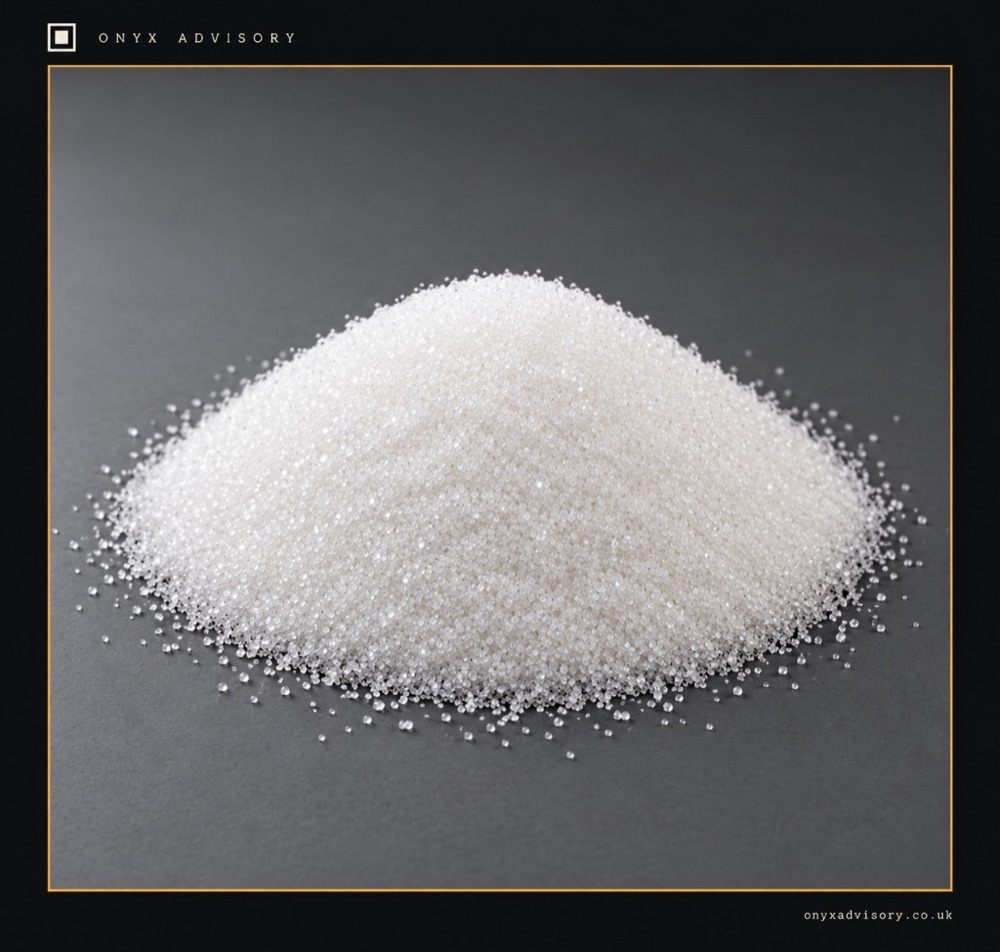
- Other names
- AP; perchloric acid ammonium salt
- Chemical formula
- NH₄ClO₄
- Molar mass
- 117.49 g/mol
- CAS number
- 7790-98-9
- EC number
- 232-235-1
- UN number
- UN 1442
- Appearance
- White crystalline solid
- Density
- 1.95 g/cm³
- Thermal behaviour
- Exothermic decomposition above approximately 200 °C, before melting
- Solubility in water
- 20.9 g/100 mL at 20 °C
- Crystal structure
- Orthorhombic below 240 °C; cubic above
Grades
Fractions and Conditioning
Particle-size distribution governs burning rate and casting viscosity, so AP for propellant use is supplied as separately controlled fractions rather than a single grade.
- Coarse fraction
- d50 250–400 µm
- Round, spheroidised crystals. Limits on needle-shaped crystals, fragments and sub-100 µm content to the buyer's specification.
- Medium fraction
- d50 50–75 µm
- Controlled dust content, with limits on the sub-20 µm fraction to the buyer's specification. Finer grades on request.
- Anti-caking conditioning
- Fractions can be conditioned against caking in transport and storage with tricalcium phosphate or fumed silica, typically at 0.10–0.15% of powder weight, with agent purity controlled for alkali-metal and iron impurities where the buyer's formulation requires it.
Specification
Typical Specification Parameters
Propellant-grade AP is specified tightly because trace impurities catalyse burning and moisture disrupts casting. The limits below are typical of propellant-grade requirements.
Purity
- Assay (NH₄ClO₄)
- ≥ 99.5% by mass
- Moisture
- ≤ 0.03%
- pH, 10% aqueous solution
- 4.5 – 6.0
Trace limits
- Chlorates
- ≤ 0.01%
- Chlorides
- ≤ 0.03%
- Total iron (Fe)
- ≤ 10 ppm
- Sulfated ash
- ≤ 0.05%
Each supply is certified against the specification agreed with the buyer.
Quality
Documentation and Acceptance
-
Certificate of analysis
Each batch ships with a CoA covering, as the buyer specifies: assay, moisture at the time of shipment, trace impurities including iron in ppm, and a differential sieve-analysis curve for each fraction.
-
Incoming inspection alignment
Acceptance criteria, rejection limits and retest arrangements are agreed in the contract, aligned with the buyer's incoming inspection procedure.
-
Safety data sheet
The safety data sheet for the supplied grade accompanies every batch and is available to verified buyers before order.
Logistics
Packaging and Transport
- Packaging
- Packed to the buyer's requirement in sealed, moisture-proof UN-certified packaging approved for UN 1442, Packing Group II: open-head steel drums (UN 1A2), fibre drums (UN 1G) or plastic drums, with double polyethylene liners and desiccant where required. Palletised for road, rail and sea transport under ADR, RID and IMDG.
- Transport classification
- Ammonium perchlorate is typically classified UN 1442, Class 5.1 (oxidizing substance), Packing Group II. Classification depends on particle size and condition and is confirmed per batch with the transport documentation.
- Transport modes
- Volume shipments move by road and sea. Air freight is restricted under IATA to 25 kg net per package on cargo-only aircraft, and is used only for small quantities.
Commercial
Commercial Terms
- Minimum order
- Quoted per requirement.
- Lead time
- Quoted per requirement. Lead time is governed largely by export authorisation in the producer's country.
- Incoterms
- FOB, CFR or CIF.
- Payment
- Settled through independent, regulated banks against agreed delivery conditions.
- Country of origin
- Disclosed to verified counterparties.
Safety
Hazard Identification
Typical GHS classification of propellant-grade AP as supplied. Fine grades below approximately 15 µm, and material heated under confinement, may be classified as explosive (Class 1.1). The safety data sheet for the supplied grade governs.
-
 GHS03 Oxidizing
-
 GHS07 Irritant
-
 GHS08 Health hazard
- Signal word
- Danger
- H271
- May cause fire or explosion; strong oxidizer
- H319
- Causes serious eye irritation
- H373
- May cause damage to organs through prolonged or repeated exposure
- EUH044
- Risk of explosion if heated under confinement
Compliance
Export Controls and End Use
- Controlled good
- Ammonium perchlorate is a controlled item under military and dual-use export control lists. Supply proceeds under export authorisation in the producer's country and, where Onyx arranges supply between third countries, under UK trade-control licensing.
- End-user documentation
- An end-user certificate signed by the end user, in the format prescribed by the producer's export authority, is obtained and verified before any commitment is made, with delivery verification where the licence requires it. Counterparties, end users and destinations are screened in line with the firm's compliance policy.
Enquiries
Specifying a Requirement
A complete requirement allows a producer to be matched and a quotation prepared in one pass. Include as much of the following as applies.
- Fractions required, with target d50 and tolerances
- Particle-size distribution limits, including dust and oversize content
- Crystal shape requirements
- Assay, moisture and trace-impurity limits
- Anti-caking agent and loading, with any purity constraints
- Order quantity and expected annual volume
- Certificate of analysis content and incoming inspection criteria
- Packaging and palletisation requirements
- Delivery timeline, preferred Incoterms (FOB, CFR or CIF) and destination port
- End user and end use, with end-user documentation available on request
Send a Requirement
Send the specification, quantities, delivery timeline, preferred Incoterms and destination. Enquiries are handled in confidence.